


Steel structure bolts are common fasteners widely used in steel structure engineering. They are mainly applied to connect joint points of steel plates and provide reliable fastening performance. Steel structure bolts feature high strength and belong to standard fastener category. Different types of steel structure bolts correspond to different configurations and installation processes. A detailed introduction is provided below for reference.
1. Overview
Steel structure bolts fall into the category of high-strength bolts and are widely adopted in steel structure projects. Their fastening performance directly affects joint reliability, so strict performance requirements are imposed on them. High-strength bolts of Property Class 8.8 and above are generally required for steel structures, with Class 10.9 being the most commonly used, and Class 12.9 available for specific heavy-load working conditions. For applications without anti-corrosion coating requirements, plain (uncoated or black finish) bolts can be selected.
Before selecting steel structure bolts, it is necessary to understand the corresponding product type, grade and installation requirements to avoid engineering quality problems caused by improper selection.
2. Classification of Steel Structure Bolts
High-strength bolts for steel structures are mainly divided into two types: twist-off type (torshear type) high-strength bolts and large hexagon head high-strength bolts.
2.1 Large Hexagon Head High-Strength Bolts
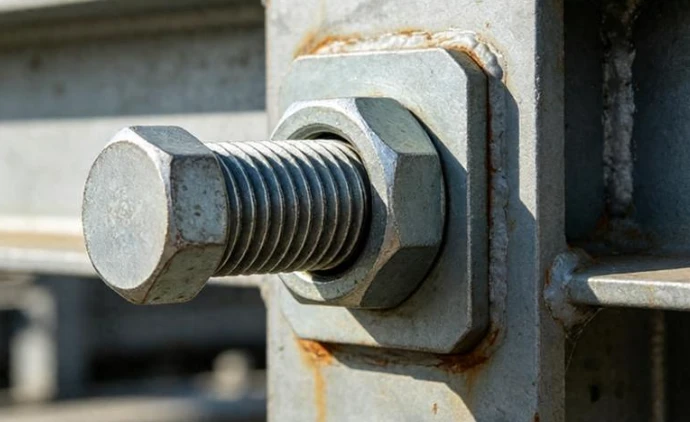
Large hexagon head high-strength bolts adopt a standard large hexagon head design and are used with matching nuts and washers. They are torque-type high-strength bolts that achieve reliable fastening by controlling preload torque, offering stable load-bearing performance and wide applicability to various working conditions.
2.2 Twist-Off Type High-Strength Bolts
Twist-off type high-strength bolts (also called tension-control bolts) are improved from large hexagon head high-strength bolts. A spline head (twist-off tail) is provided at the end of the shank. During construction, a special electric wrench clamps the nut and spline head simultaneously and tightens until the spline head breaks off along the predetermined notch, at which point the specified pre-tension has been reached. This method features simple operation, accurate pre-tension control and reduced deviation caused by manual torque adjustment.
3. Installation Process of Steel Structure Bolts
The installation of high-strength bolted joints consists of two steps: initial tightening and final tightening.
3.1 Initial Tightening
Initial tightening can be performed with impact-type electric wrenches or adjustable-torque electric wrenches. The initial tightening torque shall be controlled according to relevant specifications, so that the connected plates fit closely into position and the bolt preload remains uniform, preventing plate displacement.
3.2 Final Tightening
Different construction requirements apply to final tightening based on bolt type:
Twist-off type high-strength bolts: final tightening must be completed with a dedicated torshear-type electric wrench; final tightening is finished once the spline tail breaks off;
Large hexagon head (torque-type) high-strength bolts: final tightening shall be carried out with a torque-controlled electric wrench, and the tightening torque shall strictly follow the value specified in the design and relevant codes.
During final tightening, the tightening torque and construction sequence must be controlled accurately to avoid bolt fracture caused by over-tightening, or joint loosening caused by insufficient torque.
Conclusion
As essential connecting fasteners, steel structure bolts are widely used in steel structure engineering. Purchasers and construction personnel should fully understand bolt classification, property classes and corresponding installation methods before application, and carry out initial and final tightening in a standardized manner, so as to effectively avoid installation errors and ensure joint quality and structural safety.


