


Lock nuts and anti-loosening nuts have similar functions but different definition levels and structural working principles, and the two shall not be confused in the industry. Lock nut is a broad general concept, while anti-loosening nut refers to a special fastener with high-level vibration resistance and professional anti-loosening performance.
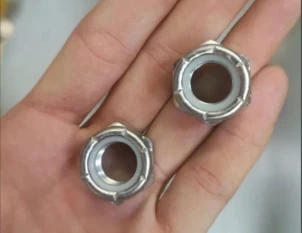
The anti-loosening effect of lock nuts mainly relies on the contact friction force generated between the meshing threads of bolts and nuts to achieve self-locking. There are various methods to improve thread meshing friction, including thread structure optimization, surface roughening of nylon rings, special thread surface modification, coating treatment, and neck closing deformation. Spiralock improved thread structures and conventional nylon lock nuts both adopt this locking principle.
Conventional lock nuts only provide basic static self-locking performance. They are still prone to loosening under high-frequency vibration, alternating loads and strong impact conditions, resulting in a low anti-loosening grade. Ordinary self-locking nuts, nylon nuts and closing nuts commonly seen in applications all belong to the category of lock nuts and do not possess high-strength anti-vibration and anti-loosening capabilities.
Anti-loosening nuts were originally developed based on foreign precision anti-loosening technology. Their working principle is to attach high-performance engineering plastic to the thread surface or adopt a special variable-profile thread structure. During tightening and meshing, continuous and stable reverse preload is generated through material compression rebound or thread profile interference, which greatly increases the friction between internal and external threads and provides lasting resistance against high-frequency vibration and repeated impact, making them suitable for harsh working conditions.
Definition classification: Ordinary non-self-locking nuts have no friction self-locking effect and can slide freely along the screw rod. Lock nuts realize basic self-locking by friction and are applicable to general working conditions. As advanced dedicated fasteners, anti-loosening nuts are specially designed for severe scenarios with strong vibration and high impact, which can stably prevent thread loosening and thread back-off for a long service cycle.
At present, mainstream professional anti-loosening nuts are mainly divided into two types:
1. Single variable-profile anti-loosening nut: Tested by the China Academy of Machinery Science and Technology, its anti-loosening stability rate reaches approximately 82%. It meets conventional industrial anti-loosening requirements but fails to pass aerospace-grade anti-loosening tests and is not applicable to high-precision aerospace working conditions.
2. Dual variable-profile anti-loosening nut: Tested by the China Academy of Machinery Science and Technology, its anti-loosening stability rate reaches up to 95% with excellent anti-loosening performance. This product has fully passed the complete anti-loosening performance test of the aerospace system, and its technical indicators exceed the general aerospace standards by two grades, serving as a high-reliability and high-vibration-resistance premium anti-loosening fastener.
Dual variable-profile anti-loosening nuts are the preferred choice for equipment assembly scenarios requiring high-strength anti-loosening performance and high reliability.


