


Fishtail bolt (egg neck bolt) is mostly used in the connection of rail joint splint (fishtail plate), which plays a fixed role. Sometimes it can also be replaced by hexagon bolt.
In fact, except for some special products, the manufacturing process of most bolts is basically the same. Today, let's go to this fishtail bolt production video of Jinrui to explain the bolt production process in detail.
annealing
Take the fishtail bolt in the above video for example. The first thing is to deal with the wire. First select the appropriate wire, then heat the wire to the appropriate temperature, keep it for a period of time, and then cool it slowly. The purpose of this is to reduce the original hardness of the wire rod and make the wire rod better processed by adjusting the crystal structure of the wire rod. This step is called annealing.

Spheroidizing annealing furnace
pickling
The next step is acid pickling and phosphating. The wire is soaked in a specific acidic solution and then cleaned. This step is to remove the oxide film on the surface of the wire. At this time, a layer of phosphate film is formed on the surface of the metal, which will reduce the damage of the wire to the processing die in the next processing process and become easier to be processed and formed.

Pickling tank
Draw line
After the above two steps, our wire rod has basically recovered to the original luster, so the next step is to fine process the wire rod, that is, draw the treated wire rod to the corresponding thickness according to the needs of customers' products, and then proceed to the next forming process.

Drawing machine
forming
In this step, the wire rod needs to be cut into the required length through the cold heading machine, and the nut and mark are made at the same time. For some self tapping screws, the tail clamping operation needs to be carried out after this step to make a "dovetail" that can penetrate the articles. For example, our fishtail bolts do not need these and go directly to the next step,
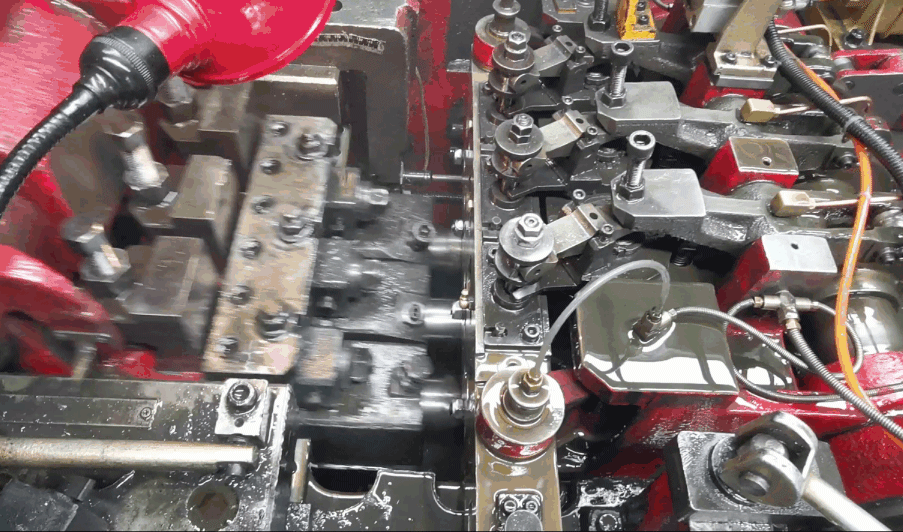
Cold heading machine
Rubbing teeth
Thread rolling is also called tooth rolling. Through the interaction between the movable tooth plate and the fixed tooth plate, the formed semi-finished products are rubbed out of our familiar threads. At this step, a fishtail bolt has been basically formed.

Tooth rubbing machine
heat treatment
The next step is called heat treatment, which needs to choose different heat treatment methods according to different objects and use purposes. The general procedure here is to clean first, remove the grease attached to the bolt surface in the production process, and then burn with high-temperature carbon, which is also the core link of the whole heat treatment. The purpose is to let carbon atoms penetrate into the surface layer of the bolt, so as to increase the hardness of the bolt. Then quenching. The carburized bolt is quenched at high temperature, so that a layer of crystal can be formed on the surface of the bolt, which has reached the final hardness requirements. Then clean the quenching oil on the bolt surface and carry out the next low-temperature tempering. This is to reduce the hardness of the bolt core and increase the plasticity and toughness of the bolt.

Heat treatment mesh belt furnace
After the above process, the fishtail bolt will be sent to the testing room to test various parameters. After the product passes the test, it will enter the next step. According to the requirements of customers, the product will be subject to various surface treatments, such as electroplating, hot-dip galvanizing, mechanical plating, etc., so as to improve the corrosion resistance of the product. Finally, the bolt will be packaged and delivered according to the model.
A small bolt seems simple, but in fact the production process is also very complex. If you need and are interested, you are also welcome to Jiangsu Jinrui metal products. We will take you to the field to learn more about it.


