


I. What is a Flange Bolt?
A flange bolt is mainly composed of three parts: a hexagonal head, a flange (a gasket fixed integrally with the hexagon below the hexagonal head), and a screw (a cylinder with external threads). It is a type of fastener that needs to be used with a nut to fasten and connect two parts with through holes.
This connection form is called bolt connection. If the nut is unscrewed from the bolt, the two parts can be separated, so bolt connection is a detachable connection.
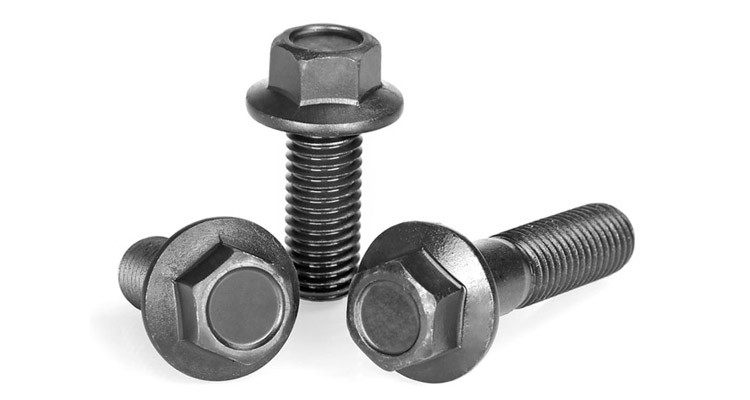
Flange bolts are common fasteners, widely used in highways and railway bridges, industrial and civil buildings, cranes, excavators and other heavy machinery fields, with a very wide scope of application.
II. Classification of Flange Bolts
1. Hexagonal flange type: There are two types of hexagonal heads, one is flat-headed and the other is concave-headed.
2. Surface color category: According to different usage requirements, the surface treatment includes white zinc plating, military green, color yellow, and Dacromet treatment which is never rusty.
3. Flange category: According to the different application scenarios of flange bolts, the size requirements of the flange are different, and it is divided into flat bottom and toothed types. The toothed flange can play an anti-skid role.
4. According to the connection force mode: divided into ordinary type and reamed hole type. The flange bolt for reamed hole needs to be accurately matched with the size of the hole, and is suitable for occasions bearing transverse force. In addition, to meet the locking needs after installation, some flange bolts are provided with holes on the rod part, which can prevent the bolts from loosening when subjected to vibration; the unthreaded polished rod part of some flange bolts is made thin, which is called thin rod flange bolt. This kind of bolt is conducive to the connection bearing variable force. The high-strength flange bolts specially used for steel structures have a larger head size and corresponding adjustments in the overall size.
III. Common Materials of Flange Bolts
1. High carbon steel (C%>0.45%): At present, it is basically not used in the production of hexagonal flange bolts in the market.
2. Medium carbon steel (0.25%<C%≤0.45%): Domestically, it is usually called 35# steel and 45# steel, and the commonly used foreign grades are 1035, CH38F, 1039, 40ACR, etc. It is mainly used for the production of grade 8 nuts, 8.8 grade bolts and 8.8 grade socket head cap products.
3. Low carbon steel (C%≤0.25%): Domestically, it is usually called A3 steel, and the commonly used foreign grades are 1008, 1015, 1018, 1022, etc. It is mainly used for the production of 4.8 grade bolts, 4 grade nuts, small screws and other products without hardness requirements. (Note: Drill tail nails mainly use 1022 material.)
4. Alloy steel: Alloying elements are added to plain carbon steel to improve the special properties of the steel. Commonly used grades include 35CrMo, 40CrMo, SCM435, 10B38, etc. Hexagonal flange bolts mainly use SCM435 chromium-molybdenum alloy steel, whose main components include carbon (C), silicon (Si), manganese (Mn), phosphorus (P), sulfur (S), chromium (Cr), molybdenum (Mo).
IV. Flange Bolt Fastening Methods and Requirements
(I) Torque-free box wrench or hammer wrench
It is suitable for the fastening of general equipment and pipeline flanges, and should be selected according to the bolt size and flange pressure level. The fastening requirements are as follows:
1. The maintenance unit shall formulate a fastening plan, number the flanges in the fastening sequence according to the symmetry principle, with reference to the numbering methods in Figure 1 and Figure 2.
2. At positions numbered 1, 2, 3, and 4, use 4 bolts to position the gasket to ensure that the center of the spiral wound gasket is within the edge of the flange.
3. Hand-tighten the positioning bolts, then insert other stud bolts and tighten them to keep the load balanced, ensuring that at least 2 threads are exposed at each end of the nut.
4. According to the on-site equipment and flange conditions, with one tightening circle as one time, reasonably formulate the number of tightening times (at least 3 times) and the hammering load (force) for each tightening; the tightening hammering load shall be increased in order from small to large (such as 50%, 80%, 100%), and the load shall not be loaded too fast or too large to prevent gasket seal failure.
5. The sequence of each tightening with a torque-free box wrench or hammer wrench:
a. Tighten the two radially opposite bolts to the specified hammering load (force);
b. Tighten another pair of bolts about 90 degrees around the circumference from the previous two bolts;
c. Continue tightening until all bolts reach the specified hammering load.
6. Finally, tighten all bolts in turn clockwise or counterclockwise according to 100% hammering load (force).
(II) Torque wrench
It is suitable for the fastening of important equipment and pipeline flanges such as high temperature, high pressure, flammable and explosive. The fastening requirements are as follows:
1. The maintenance unit shall formulate a fastening plan, determine the appropriate tightening torque, and conduct design review according to parameters such as bolt strength, initial sealing specific pressure and working sealing specific pressure of the gasket, and medium pressure, to prevent bolt fracture and gasket loss of elasticity due to excessive pressing force leading to seal failure.
2. Number the flanges in the fastening sequence according to the symmetry principle.
3. At positions numbered 1, 2, 3, and 4, use 4 bolts to position the gasket to ensure that the center of the spiral wound gasket is within the edge of the flange.
4. Hand-tighten the positioning bolts, then insert other stud bolts and tighten them to keep the load balanced, ensuring that at least 2 threads are exposed at each end of the nut.
5. According to the on-site equipment and flange conditions, with one tightening circle as one time, reasonably formulate the number of tightening times (at least 3 times) and the torque for each tightening; the tightening torque shall be increased in order from small to large (such as 50%, 80%, 100%), and the load shall not be loaded too fast or too large to prevent gasket seal failure.
6. The sequence of each tightening with a torque wrench:
a. Tighten the two radially opposite bolts to the specified torque;
b. Tighten another pair of bolts about 90 degrees around the circumference from the previous two bolts;
c. Continue tightening until all bolts reach the specified torque.
7. Finally, tighten all bolts in turn clockwise or counterclockwise according to 100% specified torque value.
8. Record the torque value each time for reference in subsequent maintenance.
(III) Bolt tensioner
It is suitable for the fastening of important equipment and pipeline flanges such as high temperature, high pressure, flammable and explosive. The fastening requirements are as follows:
1. The maintenance unit shall formulate a fastening plan, determine the appropriate tensile force, and conduct design review according to parameters such as bolt strength, initial sealing specific pressure and working sealing specific pressure of the gasket, and medium pressure, to prevent bolt fracture and gasket loss of elasticity due to excessive pressing force leading to seal failure.
When using a bolt tensioner to stretch and fasten bolts individually (step by step), it is necessary to follow the principle of uniform bolt fastening and refer to the fastening sequence of the torque wrench for stretching and fastening.
During the stretching and fastening process of the bolt tensioner, it is necessary to reasonably formulate the number of stretching and fastening times, and the pressure shall be increased in order from small to large (such as 50%, 80%, 100%) to achieve uniform pressure; each time the pressure is increased to a certain level, it is necessary to stabilize the pressure before continuing to increase the pressure, so as to avoid excessive impact tension affecting the pre-tightening effect of the bolt.
4. Record the pressure value each time for reference in subsequent maintenance.


