


It is common industry knowledge that bolts are classified by strength grades. Similarly, nuts also have corresponding strength and precision grades. Nuts and bolts work in pairs to achieve fastening functions. Reasonable grade matching between bolts and nuts is essential to ensure the reliability of threaded connections. This article elaborates on the classification of nut grades and the standard matching principles for bolt and nut assemblies.
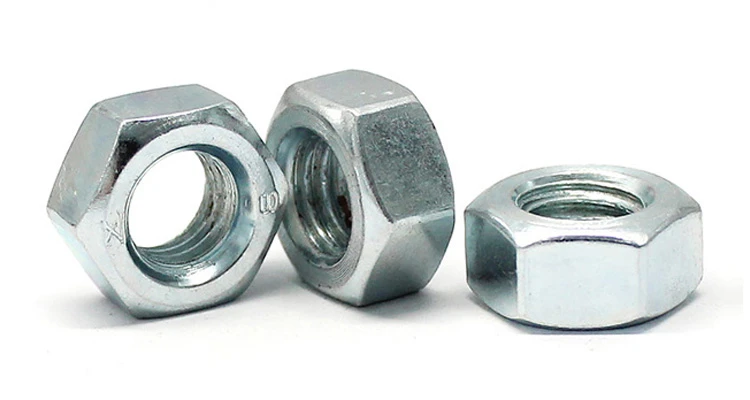
1. Classification of Nut Grades
According to different implementation standards, nuts can be classified into standard nuts, non-standard nuts, old national standard nuts, new national standard nuts, American standard nuts, British standard nuts, German standard nuts and other types. Based on nominal thickness, common hexagonal nuts are divided into Type Ⅰ, Type Ⅱ and thin types. Nuts of Grade 8 and above are mainly manufactured in two structural forms: Type Ⅰ and Type Ⅱ.
Type Ⅰ hexagonal nuts are the most widely used and are divided into three precision grades: Grade A, Grade B and Grade C. Grade A and Grade B nuts are applicable to mechanical equipment and structural components requiring high surface quality and assembly precision. Grade C nuts are used for general equipment and structures with rough surfaces and low precision requirements. Type Ⅱ hexagonal nuts have greater thickness and are mainly applied in working conditions requiring frequent assembly and disassembly.
Common National Standards for Nuts (GB)
GB 41 Type Ⅰ Hexagonal Nuts – Grade C GB 6170 Type Ⅰ Hexagonal Nuts – Grade A/B GB 6171 Type Ⅰ Fine Pitch Hexagonal Nuts – Grade A/B GB 6172 Thin Hexagonal Nuts (Chamfered) – Grade A/B GB 6173 Fine Pitch Thin Hexagonal Nuts – Grade A/B GB 6174 Thin Hexagonal Nuts (Non-chamfered) – Grade B GB 6175 Type Ⅱ Hexagonal Nuts – Grade A/B GB 6176 Type Ⅱ Fine Pitch Hexagonal Nuts – Grade A/B GB 6177 Hexagonal Flange Nuts – Grade A GB 55 Thick Hexagonal Nuts GB 56 Extra Thick Hexagonal Nuts GB 1229 High-Strength Large Hexagonal Nuts for Steel Structures
2. Strength and Precision Grade Classification of Bolts and Nuts
Common metric bolt strength grades: 4.6, 4.8, 5.8, 6.8, 8.8, 9.8, 10.9, 12.9. Common metric nut strength grades: 4, 5, 6, 8, 10, 12. Among them, Grade 4 and Grade 5 are dedicated strength grades for thin nuts.
The precision grades A, B and C of nuts correspond to American standard performance grades G2, G5 and G8 respectively. In accordance with standard J995, their mechanical properties are basically equivalent.
Type Ⅰ nuts cover thread specifications from M1.6 to M64, with performance grades including 6, 8, 10, A2-50, A2-70, A4-50, A4-70, CU2, CU3 and AL4. The product precision is divided into Grade A and Grade B. Grade A applies to specifications ≤ M16, while Grade B applies to specifications > M16.
Type Ⅱ nuts cover thread specifications from M5 to M36, with typical strength grades of 9 and 12. They are also classified into Grade A and Grade B in precision. Grade A is used for sizes ≤ M16, and Grade B for sizes > M16. Due to higher strength requirements, Type Ⅱ nuts are thicker than standard Type Ⅰ nuts.
Bolt strength grades include 3.6, 4.6, 4.8, 5.6, 6.8, 8.8, 9.8, 10.9 and 12.9. Bolts of Grade 8.8 and above are made of medium-carbon steel or low-alloy steel and undergo quenching and tempering heat treatment, defined as high-strength bolts. All other grades are classified as ordinary bolts.
3. Matching Principles for Bolt and Nut Grades
Metric bolts and nuts must be matched according to their strength grades. Improper combinations, such as an 8.8-grade bolt paired with a Grade 4 nut, feature excessive strength mismatch and do not comply with assembly specifications.
General matching rule: The integer part of the bolt strength grade corresponds to the matched nut grade. An 8.8-grade bolt matches a Grade 8 nut, and a 10.9-grade bolt matches a Grade 10 nut. The decimal part of the bolt grade indicates that its yield strength accounts for 80% of its tensile strength, ensuring consistent mechanical performance between the bolt and nut.
Flexible matching is allowed according to actual service conditions. In scenarios where nuts are difficult to replace while bolts are easy to disassemble and renew, a low-strength bolt can be matched with a higher-strength nut, such as a 4.8-grade bolt paired with a Grade 5 nut.
In some working conditions, nuts are intentionally selected with slightly lower strength than bolts for safety and cost considerations. Bolt failure tends to occur suddenly without obvious early warning, while nut damage is easier to detect in advance. Matching lower-strength nuts with higher-strength bolts enables the nut to fail first under fatigue load. This ensures longer service life of bolts, improves connection safety, and reduces the difficulty and cost of later disassembly and replacement of fasteners.


