


T-bolts and U-bolts are completely different types of fasteners. They are introduced together here only because their names are similar. Using a single letter to describe a bolt is uncommon in the fastener industry, and the most representative examples are exactly T-bolts and U-bolts.
Currently, only two material versions are available for T-bolts (also known as hammer-head bolts): Grade 8.8 carbon steel T-bolts with a black oxide or electro-galvanized finish, and SUS304 stainless steel T-bolts with a natural raw material finish. There is no production plan for SUS316 material at present. T-bolts are mainly used for installation on aluminum profiles. Their head is T-shaped, allowing sliding and positioning inside profile grooves. The threaded end is usually matched with flange nuts. When tightening the nut, the T-head is locked in the profile groove and does not rotate with the nut, making installation very convenient.The national standard code for T-bolts is GB/T 37, with the full name "Bolts for T-Slots", commonly shortened to T-bolts. Their thread diameters range from M5 to M12, while the most widely available sizes on the market are M6, M8, and M10. Lengths vary widely, from 10 mm to 100 mm, based on design requirements. Below we explain the key points from the technical drawings of these three common sizes.

The top-left drawing shows a T-slot bolt of size M6×25, and the right one shows M8×25. The two sizes have the same thread length, differing only in head width across flats and maximum outer diameter. Due to space limitations, the drawing for the M10 T-bolt is not included here.
U-bolts are also called pipe clamps. They are U-shaped with threads at both ends, mainly used for pipeline installation. Like T-bolts, they are available in two material options: electro-galvanized carbon steel U-bolts and SUS304 stainless steel U-bolts. U-bolts are clamped directly onto pipes, with the other end used to connect other components and locked with nuts. Due to their installation shape, they are also known as saddle bolts.The standard for U-bolts is JB/ZQ 4321-1998. We also present technical drawings of M6 and M8 U-bolts for a straightforward analysis of their product features.
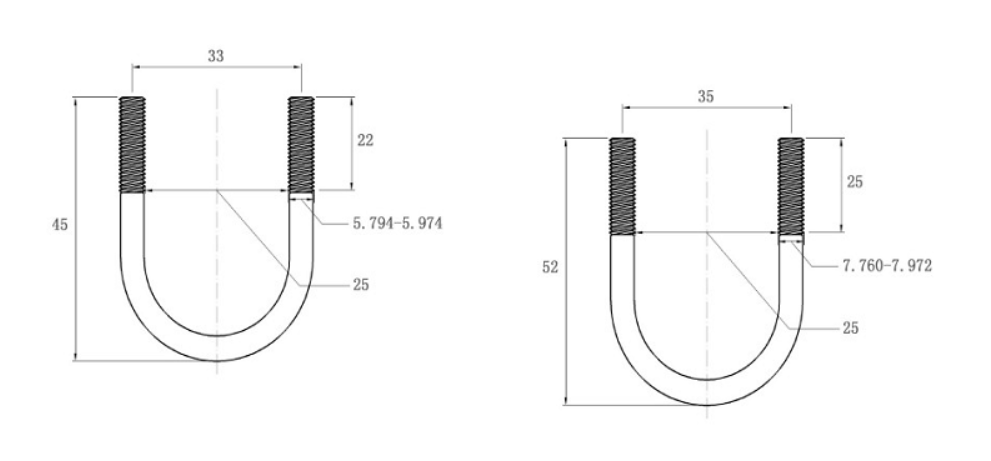
The left part shows a SUS304 U-clamp of size M6×25, with M6 threads and an opening width of 33 mm (including rod diameter), mainly for pipes with an outer diameter of 25 mm. Installation is completed by clamping it around the pipe and tightening a nut on the threaded end. The right one is M8×25, with an M8 thread diameter, suitable for pipes with an outer diameter of 25 to 30 mm.
U-bolts hold a special position among fasteners, mainly due to their shape and unique sizing method. A regular bolt is simply specified by thread diameter plus length, but U-bolts are designed to clamp around pipes and have specific requirements for opening size and clamping length, so they cannot be defined merely by thread diameter and length.
When U-bolts first appeared, they were called saddle bolts because of their installation style-like a saddle straddling a pipe. As this name was considered inconsistent with the nature of metal fasteners, they were officially named U-bolts in standardization based on their shape.
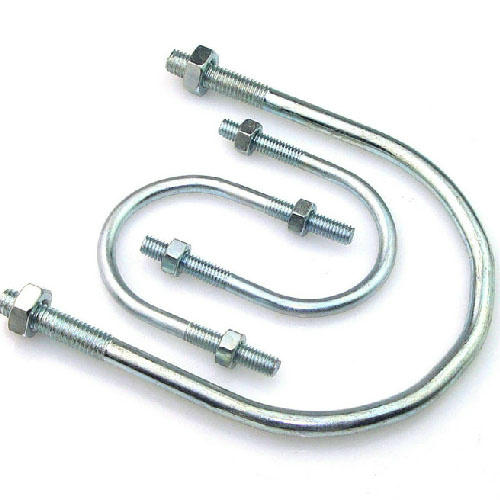
The picture above shows a standard U-bolt. It is made by bending a single rod into a U-shape and forming threads at both ends. After clamping it around a round pipe, a clamping plate is fitted onto the threaded ends, and locking is achieved by tightening the nuts.To clearly specify a U-bolt, the first parameter is the material, which is the same as for regular bolts: carbon steel or stainless steel, with the same description method. Next is the thread diameter. Like regular bolts, U-bolts come in different thread sizes, commonly starting from M6, with sizes above M12 rarely used, so U-bolt thread options are limited.Another critical dimension is the opening width-the inner space formed by bending, which matches the outer diameter of the pipe and uses a positive tolerance. For example, for a pipe with an 80 mm outer diameter, the opening width is approximately 85 mm for easy installation. Besides the opening width, the height of the U-bolt must also be specified: this refers to the length of exposed threads after installation, which depends on the components to be connected later.
U-bolts are widely used, especially in outdoor construction and conveying equipment. Depending on the application environment, shapes are not limited to the U-type; square and triangular versions also exist, with the U-shape being the most common. For instance, the square saddle bolt shown below is still generally referred to as a U-bolt in the industry.

Normally, carbon steel U-bolts without a specified strength grade are made from Q235 mild steel, mostly with an electro-galvanized surface. For critical applications such as power facilities where strength is required, 45# carbon steel is used. For outdoor service, hot-dip galvanizing is often applied. All these are supplied according to customer requirements, not mandatory unified standards.For stainless steel U-bolts, SUS304 is the dominant material. SUS316 U-bolts are not available from stock in the market; custom orders with advance placement are required for production.


