


U‑bolts are widely used in various engineering and equipment. They get their name from their U‑shaped profile. This article gives a comprehensive introduction to the basic parameters, materials, processing technologies and application scenarios of U‑bolts.
Basic Information of U‑bolts
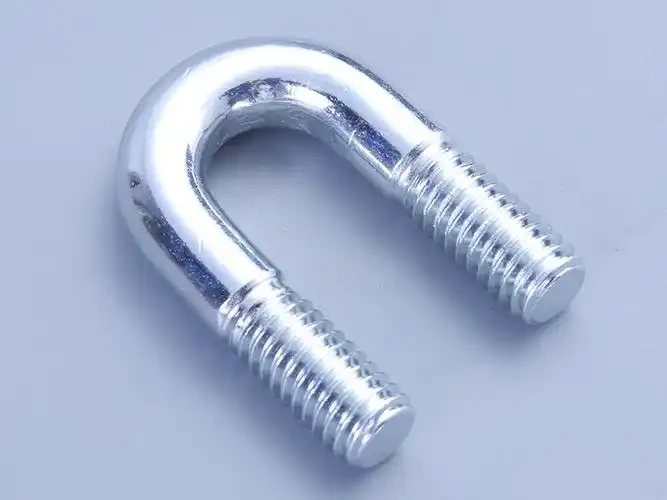
Product Name: U‑bolt, also known as saddle bolt, U‑screw, U‑pipe clamp. It features a U‑shaped body with external threads on both ends for tightening with matching nuts. It is mainly used to fasten tubular workpieces such as water pipes and pipelines, as well as sheet‑type components like automotive leaf springs.
Thread tolerance: 6g Applicable standard: JB/ZQ4321‑2006, replacing the old version JB/ZQ4321‑1997. Property classes: 4.8, 6.8, 8.8, 10.9. Surface treatments: black oxide, yellow zinc plating, white zinc plating, hot‑dip galvanizing, sherardizing, Dacromet coating. Common shapes: semicircular, square right‑angle, triangular, oblique triangular.
Materials: carbon steel Q235A, Q345B, alloy steel and stainless steel. Common stainless‑steel grades include 201, 304, 321, 304L, 316, 316L.
Material properties including density, bending strength, impact toughness, compressive strength, modulus of elasticity, tensile strength and temperature resistance shall be selected according to actual service conditions. By material, U‑bolts fall into two main categories: carbon‑steel U‑bolts and stainless‑steel U‑bolts.
Processing Technology of U‑bolts
U‑bolts are non‑standard fasteners, formed by two main processes: cold bending and hot bending. During production, raw long rod blanks are bent into U‑shape by applying external force with baffle plates and forming steel dies, followed by thread machining at both ends. Cold bending applies to small‑and‑medium sizes, while hot bending is generally adopted for large‑diameter and high‑strength specifications to avoid cracks and stress concentration at bending sections. Simple traditional tooling using only a single steel baffle tends to deform and shift outward under heavy bending force, resulting in poor workpiece accuracy.
Application Fields of U‑bolts
U‑bolts have extensive applications in building installation, mechanical component connection, trucks, ships, bridges, tunnels and railways.
For trucks, U‑bolts secure chassis and frames. A typical application is clamping automotive leaf springs. They provide clamping force to prevent components from shifting or slipping under heavy‑load conditions and deliver reliable fixing and pressure‑bearing performance.
They are also used for pipeline bundling, limiting and locking equipment parts, and are widely adopted in workshop production equipment and pipeline supports.
To sum up, thanks to their simple and reliable structure, U‑bolts play a vital fastening role in machinery, transportation, construction and many other fields. Material, strength class and surface treatment shall be selected based on load, corrosive environment and temperature to ensure long‑term stable operation of equipment.


