


Many of us think that bolts won't rust after galvanization, but this is not the case. Zinc plated bolts do not become completely rust-proof; instead, galvanization significantly extends the time it takes for them to rust. Therefore, when using bolts, it is crucial whether the selection of their surface treatment matches the environmental requirements-only by choosing a surface treatment method suitable for the service environment can the rust resistance of zinc plated bolts reach its optimal state. Of course, the corrosion resistance of galvanization (specifically referring to electrogalvanizing, i.e., cold galvanizing here) is not the best among all surface treatments, but electrogalvanized bolts are one of the surface-treated fasteners with relatively large market share. Compared with Dacromet treatment and hot-dip galvanizing (hot-dip galvanizing is also a type of galvanization, with better rust resistance than electrogalvanizing), electrogalvanization is more widely used due to its lower cost and simpler process.
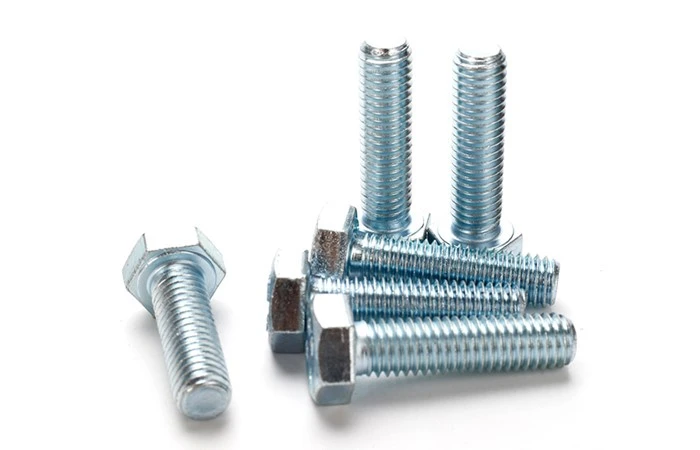
Before the production of zinc plated bolts, relevant technical parameters have been clearly marked on the drawings, including wire specifications, wire drawing dimensions, mold parameters, thread standards, and even the rigid requirements for bolt packaging. Only by documenting and standardizing these requirements can the production implementation be ensured; relying solely on verbal descriptions makes it difficult to achieve standardized production.
But why do zinc plated bolts still rust even when produced according to standards? First, it is necessary to clarify that the surface galvanization treatment (electrogalvanizing) of bolts is a relatively conventional process, and its rust resistance is indeed inferior to that of hot-dip galvanizing and Dacromet. If design permits, hot-dip galvanizing or Dacromet treatment, which have longer rust-proof cycles, can be selected. The main functions of electrogalvanization are to improve surface aesthetics and enhance basic corrosion resistance. Its corrosion resistance is more suitable for fixed environments indoors that are dry and free of corrosive media. If electrogalvanized bolts are used in high-salt-spray environments such as coastal areas, they will likely rust severely within less than a year.
Common Causes of Rusting in Zinc Plated Bolts
Rusting of zinc plated bolts is not entirely a quality issue (this specifically refers to cases where electrogalvanizing is incorrectly selected during design, leading to non-compliance with service requirements in harsh environments. If electrogalvanized bolts still rust frequently in normally suitable environments, it is most likely a problem with the coating quality). It is necessary to identify the root cause from the design perspective and ensure that the design concept aligns with actual service requirements.
1,Improper Packaging Timing and MethodIf bolts rust before use, it is necessary to check whether the rust is caused by improper subsequent handling. For example, when bolts are transported from the galvanizing plant to the warehouse, if they are immediately sealed in packaging bags before their surface temperature has completely cooled down, the temperature difference between the inside and outside of the bag will cause water vapor in the air inside the packaging to condense into water droplets. These water droplets will cause severe corrosion to the bolt surface coating, leading to rusting in a short period. Therefore, the timing (waiting for complete cooling) and process (avoiding premature sealing) of bolt packaging and warehousing are particularly important.
2,Humid Storage EnvironmentThe storage environment for zinc plated bolts must have good ventilation. Take Wuxi, Jiangsu Province as an example-from January to May every year, the city experiences the plum rain season, during which the indoor air humidity is extremely high. If electrogalvanized bolts are stored in such a humid environment, the coating easily absorbs moisture from the air, accelerating the rusting process and causing rust to appear in a short time.
3,Substandard Coating Process by ManufacturersIf the technical level of the zinc plated bolt manufacturer is insufficient, it may lead to defects in the coating, such as missing plating on the thread, uneven coating thickness, or incomplete passivation treatment. These coating defects will leave parts of the bolt unprotected, exposing them directly to air and moisture, thereby causing rusting.


