


There are various reasons for bolt fracture in fasteners. Generally speaking, bolt damage is caused by stress factor, fatigue, corrosion, and hydrogen embrittlement.
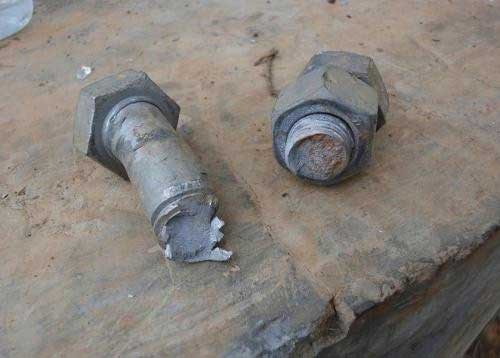
Bolt fracture
1. Stress factor
Exceeding conventional stress (overstress) is caused by any one or a combination of shear, tension, bending, and compression.
Most designers first consider the combination of tensile load, preload force, and additional practical load. Pre tightening force is basically internal and static, which compresses the joint components. Practical loads are external, typically cyclic (reciprocating) forces applied to fasteners.
The tensile load attempts to resist the joint components from opening. When these loads exceed the yield limit of the bolt, the bolt changes from elastic deformation to plastic deformation, resulting in permanent deformation of the bolt. Therefore, it cannot be restored to its original state when the external load is removed. For similar reasons, if the external load on the bolt exceeds its ultimate tensile strength, the bolt will break.
Bolt tightening is achieved by twisting with preload force. During installation, excessive torque leads to overtightening and reduces the axial tensile strength of fasteners by subjecting them to overstress. In other words, bolts subjected to continuous torsion have lower yield values compared to bolts directly subjected to tension and tension. In this way, the bolt may yield before reaching the minimum tensile strength of the corresponding standard. A large torque can increase the pre tightening force of the bolt and correspondingly reduce the looseness of the joint. In order to increase the locking force, the pre tightening force is generally set at an upper limit. In this way, unless the difference between yield strength and ultimate tensile strength is small, bolts generally will not yield due to torsion.
Shear load applies a vertical force to the longitudinal axis of the bolt. Shear stress is divided into single shear stress and double shear stress. From empirical data, the ultimate single shear stress is approximately 65% of the ultimate tensile stress. Many designers prefer shear loads because they utilize the tensile and shear strength of bolts. They mainly act like dowels, forming relatively simple connections for fasteners subjected to shear. The disadvantage is that shear connections have a limited range of applications and cannot be used frequently, as they require more materials and space. We know that the composition and accuracy of materials also play a decisive role. However, material data that converts tensile stress into shear load is often unavailable.
The pre tightening force of fasteners affects the integrity of shear connections. The lower the preload force, the easier it is for the joint layer to slide when in contact with the bolt. The shear load capacity is calculated by multiplying the number of transverse planes (one shear plane is called single shear, and two shear planes are called double shear), which should be the cross-sections of unthreaded bolts. We do not advocate designing shear through threads, as the shear strength of fasteners can be overcome by stress concentration when the cross-section changes. When determining the shear strength of fasteners, some designers use the tensile stress area, while others prefer small-diameter sections. If the bolt in the shear connection is twisted to the specified value (as shown in Figure 2), the mating surface of the contact layer cannot start sliding until it exceeds the frictional resistance outside. Increasing the friction between mating surfaces can improve the overall integrity of the connection. Sometimes, due to the size of the parts and design requirements, the number of bolts that must be used may be limited.
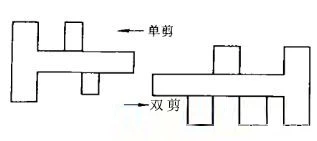
Figure 2: Regardless of whether the connecting component is single cut or double cut, the cutting surface should not pass through the threaded part of the fastener
In addition to tensile and shear loads, bending stress is another load that bolts experience, caused by external forces that are not perpendicular to the longitudinal axis of the bolt and are located on the bearing and mating surfaces. Overall, the simpler the fastener connection, the greater its integrity and reliability.
2. Fatigue
There is currently no specific legislation directing suppliers to purchase key components that comply with industrial standards in the relevant regulations for industrial fasteners, especially without mentioning the main cause of fastener failure - fatigue. Fatigue damage is estimated to account for 85% of the total number of fastener failures.
The fatigue in bolts is the continuous action of cyclic tensile loads, which results in bolts being subjected to relatively small preload forces and alternating working loads. Under such dual load conditions for a long time, bolts will fail when their rated tensile strength is less than. The fatigue life is determined by the number and amplitude of loading stress cycles. Some compressed connectors, such as presses, stamping equipment, and molding machinery, may also experience fatigue fracture. Multiple composite stresses are generated between the power and preload during operation. In repeated stretching movements, the number and amplitude of stress changes are affected by the degree of fatigue and damage.
Typical industrial fasteners, such as hex screws, constantly elongate and return to their original shape within a certain range of elasticity. If subjected to stress beyond normal and beyond the elastic range, they will undergo permanent deformation until they eventually break. The behavior of extending and returning to an extended state is called a cycle. A hexagonal socket screw can withstand approximately 240-10 ° cycles per day (maximum) as shown in Figure 3.
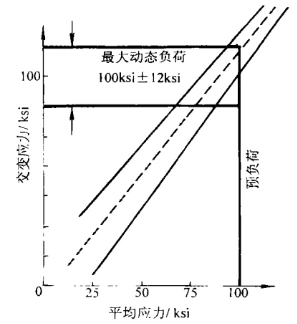
Figure 3 Improved Goodman diagram
The dotted diagonal indicates the average value of alternating screw load with a 90% probability for 10 million cycles. The actual diagonal line shows that when the screw pre tightening force reaches 100ksi, the maximum deviation between the dynamic load and the average stress is 12ksi.
Fasteners will eventually crack due to repeated stress cycles from peak to peak. Fracture usually occurs at the most vulnerable point of the fastener, which engineers refer to as the "area of maximum stress concentration". Once microcracks occur at the stress concentration point and continue to be subjected to stress, the cracks will rapidly propagate, causing fatigue damage to the fastener. Enterprises manufacturing fasteners for industrial use are constantly exploring new molding processes and designing and developing new manufacturing methods that can overcome the aforementioned fatal weaknesses.
The most common locations of fatigue failure include the joint (i.e. the first loaded thread), root fillet, thread, and thread termination. Due to the improvement of fatigue strength through the development of better materials and production methods in the manufacturing industry, threads have become the weakest point of fasteners and currently the highest proportion of damage causes in fatigue failure.
The interrelationship between the stress variables in design and the performance characteristics of fasteners makes setting fatigue strength standards a difficult task. Currently, it is a complex process to determine the number of "cycles to fracture" and measure the relative strength of a series of fasteners.
3. Corrosion
Another reason for bolt fracture is corrosion. Corrosion has many forms, including ordinary corrosion, chemical corrosion, electrolytic corrosion, and stress corrosion. Electrolytic corrosion refers to the exposure of fasteners to various moist agents such as rainwater or acid mist, which are electrolytes that can cause chemical corrosion of the fasteners; Secondly, due to the different materials of fasteners, their electrolytic potentials are different, and the potential difference can easily generate "microbatteries". Designers should choose materials with similar electrolytic potentials as much as possible based on the compatibility of metals, while eliminating the conditions for electrolyte generation to prevent cracking caused by electrolytic corrosion.
Stress corrosion is relatively limited. Stress corrosion exists under high tensile loads and mainly affects fasteners made of high-strength alloy steel. Fasteners made of alloy steel (especially steel with high alloy composition) are prone to cracking under stress. At the beginning, cracks and pits are usually formed on the surface, and then further corrosion occurs, which promotes crack propagation. The rate of crack propagation is determined by the stress on the bolt and the fracture toughness of the material. When the remaining material functions to the point where it cannot withstand the applied stress, fracture occurs.
4. Hydrogen embrittlement
High strength steel fasteners (generally with a Rockwell hardness of C36 or higher) are more prone to hydrogen embrittlement. Hydrogen embrittlement is the main cause of fastener fracture. Hydrogen embrittlement is a phenomenon in which hydrogen atoms enter and diffuse throughout the entire material matrix. When hydrogen atoms enter the material matrix, the matrix undergoes lattice distortion, disrupting the original equilibrium state and making it easy to crack under external forces. When an external load is applied to the screw, hydrogen atoms migrate to the highly concentrated stress zone, causing significant stress between the edges of the crystal boundaries, which leads to fracture between the crystal particles of the fastener.
When fasteners contain critical hydrogen before installation, they typically break within 24 hours. If hydrogen enters the fastener, it is impossible to predict when it will break. Therefore, when using relevant fasteners, designers should specify the selection of suppliers with specialized processes and minimal potential hydrogen embrittlement.
5. Other factors
Connection fracture is not always directly related to catastrophic fastener fracture. Many factors related to fasteners, such as loss of preload or fatigue of fastener connections, can cause wear and tear; The center offset of fasteners can generate noise and leakage during use, requiring unplanned maintenance to prevent breakage. For example, vibration can reduce the frictional resistance of threads, and fastener connections can relax due to the application of work loads after installation. These factors, along with the high-temperature creep of bolts, can lead to the loss of preload force. Sometimes the fracture of the connection can be attributed to the hole passing through being too large or too small, the bearing area being too small, the material being too soft, or the load being too high. Any of these situations will not cause direct bolt fracture, but will result in loss of connection integrity or eventual bolt fracture.


