


During the welding process of steel structure bolts, due to the unevenness of heating and cooling, as well as the constraints of the component itself or external constraints, after the welding work is completed, welding stress will always be generated in the component. The existence of welding stress will reduce the actual bearing capacity of welded joints and produce plastic deformation. When the welding stress is severe, it will also cause damage to the components.
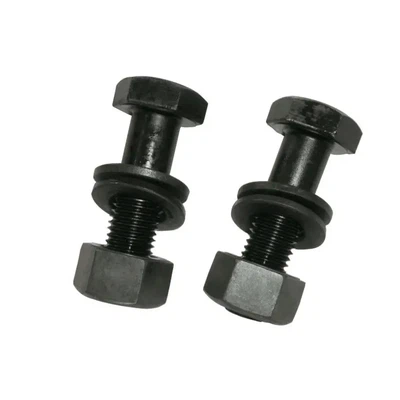
Post-weld dehydrogenation treatment refers to the low-temperature heat treatment performed after the welding is completed and when the weld is not cooled below 100°C. The general specifications are heating at 200°C, heat preservation at 350°C, and heat preservation for 2 hours and 6 hours. The main function of post-weld hydrogen removal treatment is to accelerate the hydrogen escape in the weld seam and heat-affected zone, which has a significant effect on preventing welding cracks in low-alloy steel.
Stress relief heat treatment is to reduce the yield strength of the welded workpiece at high temperature, so as to reduce the welding stress. There are two commonly used methods: one is the overall high-temperature tempering, that is, the weldment is put into a heating furnace, slowly heated to a certain temperature, then kept for a period of time, and then cooled in the air or in the furnace. This method can eliminate 80%~90% of welding stress. Another method is local high-temperature tempering, that is, only heating the weld and its adjacent areas, and then cooling slowly to reduce the peak value of welding stress and make the stress distribution relatively stable. The purpose of locally eliminating welding stress is to achieve the purpose of locally eliminating welding stress.
After some alloy steel materials are welded, hardened structures will appear in the welded joints, which will deteriorate the mechanical properties of the materials. In addition, under the action of welding stress and hydrogen, the quenched structure may cause damage to the joint. After heat treatment, the metallographic structure of the welded joint is improved, the plasticity and toughness of the welded joint are improved, and the comprehensive mechanical properties of the welded joint are improved.


