


Quenching crack is a common quenching defect, which is caused by many reasons. Since the defects of heat treatment start from product design, the work of preventing cracks should start from product design. It is necessary to correctly select materials, reasonably carry out structural design, put forward appropriate technical requirements for heat treatment, properly arrange the process route, and select reasonable heating temperature, holding time, heating medium, cooling medium, cooling method and operation mode.
Material aspect
1. Carbon is an important factor affecting quenching cracking tendency. With the increase of carbon content, Ms point decreases and quenching crack tendency increases. Therefore, under the condition of meeting basic properties such as hardness and strength, lower carbon content should be selected as far as possible to ensure that it is not easy to crack.
2. The influence of alloy elements on quenching cracking tendency is mainly reflected in the influence on hardenability, Ms point, grain size growth tendency and decarburization. Alloy elements affect the quenching cracking tendency by affecting the hardenability. Generally speaking, the hardenability increases and the quenching crack increases. However, when the hardenability increases, the quenching medium with weak cooling capacity can be used to reduce the quenching deformation to prevent the deformation and crack of complex parts. Therefore, for the parts with complex shape, in order to avoid quenching cracks, it is a better scheme to select the steel with good hardenability and use the quenching medium with weak cooling capacity.
Alloy elements have a great influence on MS point. Generally speaking, the lower the MS is, the greater the quenching crack tendency is. When the MS point is high, the martensite generated by transformation may be self tempered immediately, so as to eliminate some transformation stress and avoid quenching crack. Therefore, when the carbon content is determined, a small amount of alloy elements or steel grades containing elements that have little influence on MS points should be selected.
3. Overheating sensitivity shall be considered when selecting steel. Steel sensitive to overheating is easy to produce cracks, so attention should be paid to the selection of materials.
Structural design of parts
1. Uniform section size. For parts with sharp changes in section size, cracks occur due to internal stress during heat treatment. Therefore, sudden change of section size shall be avoided as far as possible in design. The wall thickness shall be uniform. If necessary, holes can be opened at thick wall parts not directly related to the purpose. Holes shall be made into through holes as far as possible. For parts with different thickness, split design can be carried out, and assembly can be carried out after heat treatment.
2. Fillet transition. When the part has edges, sharp corners, grooves and transverse holes, these parts are easy to produce stress concentration, resulting in quenching crack of the part. Therefore, the parts shall be designed into a shape without stress concentration as far as possible, and rounded corners shall be machined at sharp corners and steps.
3. Difference in cooling rate caused by shape factors. The fast and slow cooling speed of parts during quenching varies with the shape of parts. Even in different parts of the same part, the cooling speed will be different due to various factors. Therefore, excessive cooling difference should be avoided as far as possible to prevent quenching cracks.
Technical conditions for heat treatment
1. Try to use local quenching or surface hardening.
2. Adjust the local hardness of quenched parts reasonably according to the service conditions of parts. When the local quenching hardness requirements are low, try not to force the overall hardness to be consistent.
3. Pay attention to the quality effect of steel.
4. Avoid tempering in the first type of tempering brittle zone.
Reasonably arrange the process route and process parameters
Once the material, structure and technical conditions of steel parts are determined, the heat treatment process personnel shall conduct process analysis and determine the reasonable process route, that is, correctly arrange the positions of preparatory heat treatment, cold processing and hot processing and determine the heating parameters.
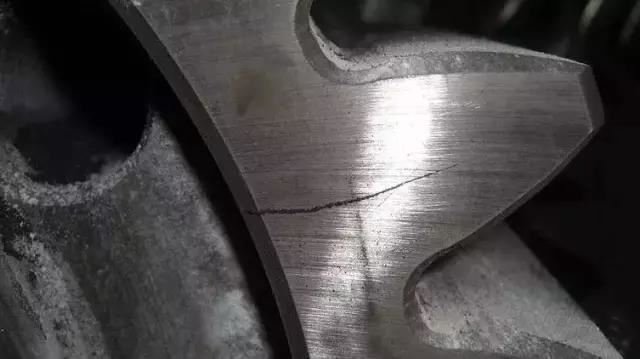
Quenching crack
At 1.500x, it is serrated, the crack at the starting end is wide, and the fracture line at the end is small to No.
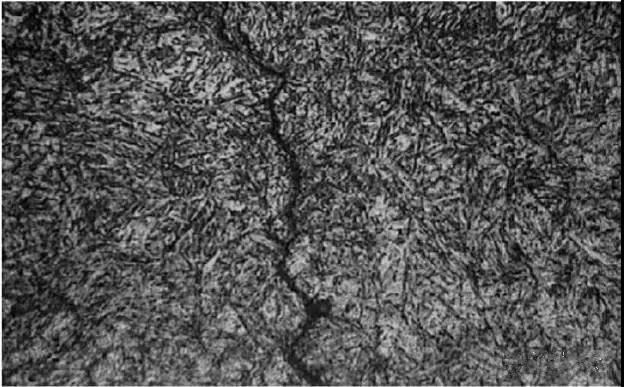
2. Microscopic analysis: abnormal metallurgical inclusion, crack morphology extending in zigzag shape; No decarburization was observed after corrosion with 4% nitric acid alcohol. The micro morphology is shown in the figure below:
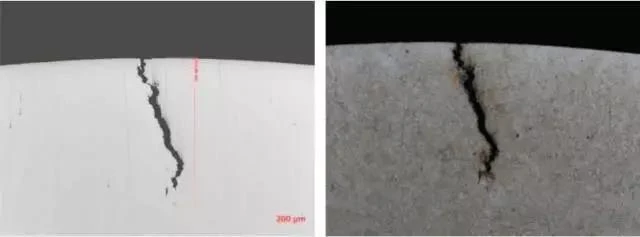
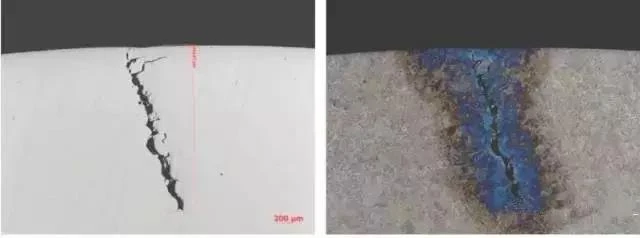
No abnormal metallurgical inclusions and decarburization are found at the crack of the product. The crack extends in a sawtooth shape, which is typical of quenching crack.
Analysis conclusion:
1. The composition of the sample meets the standard requirements and corresponds to the composition of the original heat number.
2. According to the microscopic analysis, no abnormal metallurgical inclusions and decarburization are found at the crack of the sample, and the crack extends in a sawtooth shape, which has the typical characteristics of quenching crack.
Forging cracks
1. Cracks caused by typical material, with oxide at the edge.

2. Microscopic observation


The white bright layer on the surface shall be the secondary quenching layer, and the dark black under the secondary quenching layer shall be the high-temperature tempering layer
Analysis conclusion: it is necessary to distinguish whether the crack with decarburization is a raw material crack. Generally, the crack with decarburization depth greater than or equal to the surface decarburization depth is a raw material crack, and the forging crack with decarburization depth less than the surface decarburization depth.


