


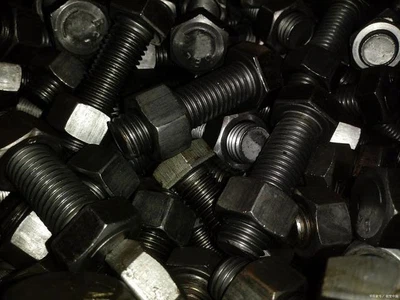
There is no good cleaning method, mainly for cleaning the residual cooling oil attached to the surface of fasteners during cold heading or cutting, and the residual oil on the surface of fasteners after quenching in heat treatment oil.
01 Alkali water cleaning method
Simple alkaline water cleaning is a direct or indirect heating type cleaning tank, and the cleaning solution is a 3%~10% N2CO3 or NaOH aqueous solution. For self tapping screws that have undergone carburizing or carbonitriding, a 5% to 10% sodium carbonate solution heated to 50-70 ℃ is often used for intermediate cleaning before tempering. The connected mesh belt furnace belongs to this category. Fastener cleaning generally adopts a dual method of spraying and immersion. If hot water is used for flushing, the effect is better, and then high-pressure airflow is used for drying. The main disadvantage of alkaline water cleaning method is that the cleaning effect is not very good, especially for blind holes and grooves of fasteners, which are prone to stains and residues. The wastewater generated from alkaline water cleaning must be neutralized and the waste oil must be recovered to meet relevant environmental requirements before it can be discharged.
02 Metal cleaning agent cleaning method
To overcome the drawbacks of alkaline water cleaning methods and improve cleaning efficiency, specialized metal cleaning agents can currently be used. The cleaning agent is diluted into a 1% -3% solution in water at 40-70 ℃, and the fasteners are soaked in the solution for 15-20 minutes, then rinsed with hot water and dehydrated using a dehydrator. Can be used in a cleaning machine. The disadvantages of using metal cleaning agents for cleaning are that they are expensive, have an unpleasant odor, have a certain corrosive effect on fasteners, and pollute the environment with wastewater. Therefore, it is necessary to treat the wastewater and recycle the waste oil.
03 Organic solvent cleaning method
Using organic solvents such as trichloroethylene and trichloroethylene for cleaning, the cleaning effect is excellent. When cleaning quenched fasteners by soaking or spraying under normal pressure, the volatilization and splashing of organic solvents pollute the environment. For this purpose, a complete set of equipment using a closed pressure reducing solvent vacuum cleaning method is applied, which uses a vacuum pump to exhaust the air. The fasteners come into contact with high-density solvent vapor in the absence of air, further improving the cleaning effect, and the solvent and oil are recovered by vacuum distillation. The solvent content in the recovered oil has been reduced from 20% to below 4%, which is lower than the environmental hygiene requirement of 50ppm for trichloroethylene.
04 Combustion degreasing method
Cold heading or machined fasteners need to be cleaned of surface oil before entering the heat treatment process. For this purpose, the fasteners can be heated to 350-400 ℃ in a degreasing furnace to vaporize or burn the oil, in order to achieve the purpose of removing oil or surface phosphorus from the fasteners. The combustion degreasing method is only suitable for cleaning before heat treatment, and can also clean light, low viscosity, and low boiling point oils such as cooling oil and rust inhibitor. After the combustion of heavy quenching oil with high viscosity and boiling point, a large amount of residue and carbon black will adhere to the surface of fasteners, which cannot achieve the purpose of cleaning.
For fasteners that require high surface cleanliness, such as aviation bolts and automotive engine connecting rod bolts, vacuum or ultrasonic cleaning techniques are currently used instead of commonly used cleaning methods that use chlorinated hydrocarbons as solvents to destroy the atmospheric ozone layer, which can achieve efficient and environmentally friendly cleaning.


