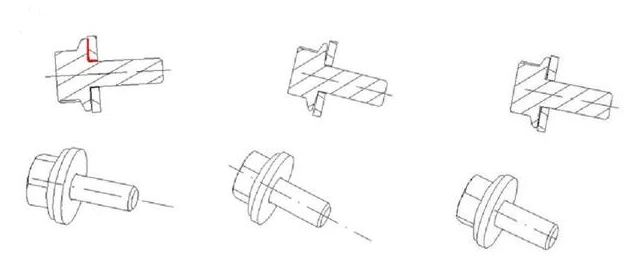
Seeing the title, some people might ask: How can a bolt, made of a hunk of metal, experience fatigue? Actually, when bolts made of carbon steel are produced into the products we need, if some technical parameters and mechanical properties fail to meet requirements from the start, during continuous use, they will gradually exert force on their local areas over time. When this force reaches the critical point, tiny cracks will appear in the bolt. The formation of such cracks is only the first step of fatigue. When the number of cycles reaches a certain level, the cracks will directly lead to fracture. This is the phenomenon and result of bolt fatigue.
So why do carbon steel bolts experience fatigue? Is it true that bolts with higher strength are more prone to fatigue? First, bolt fatigue has no direct connection with strength itself. It's just that ordinary bolts have lower strength requirements, so their application environment will not cause excessive fatigue effect on them. However, the application environment of high-strength bolts has certain requirements for tensile performance, which invisibly increases the fatigue effect on bolts. Therefore, most of the bolt fatigue we encounter in daily life involves high-strength bolts, but this does not mean ordinary bolts will not experience fatigue-it's just that our requirements for ordinary bolts are not high when using them.
Let's further look at the cause of bolt fatigue: it is the change of local stress during cyclic use that causes a certain degree of damage to the weak points of the bolt, eventually forming cracks. So the process should be like this: first, stress erodes the weak points of the bolt, then causes cracks to form in the bolt. After a period of time, the cracks grow larger and larger. At a certain critical point, the bolt suddenly fractures. After long-term analysis, we found that such fatigue stress does not require a large external force to generate. Sometimes the stress generated on the bolt is much lower than the bolt's yield strength. Therefore, after a bolt fractures due to fatigue, no signs of deformation or bending caused by external forces can be seen on the fracture surface at all.
Based on the above analysis, we can appropriately adjust some basic manufacturing processes to help bolts resist fatigue. Let's look at a diagram:

The diagram above shows the thread structure. We can make the space between threads with an R angle. Since fatigue fractures mostly occur at the thread roots and the area under the bolt head, adjusting some basic thread manufacturing processes can effectively prevent fatigue. We can compare it with ordinary threads:
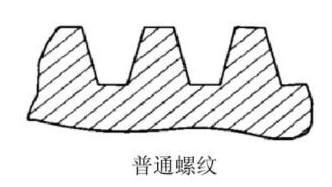
The above is an ordinary thread, where a right angle is formed between the thread teeth. This right angle responds directly to stress changes, so such right-angle threads are prone to fatigue fracture. As analyzed earlier, in addition to threads, the area under the bolt head is also a high-risk area for fatigue fracture. Let's look at the diagram:
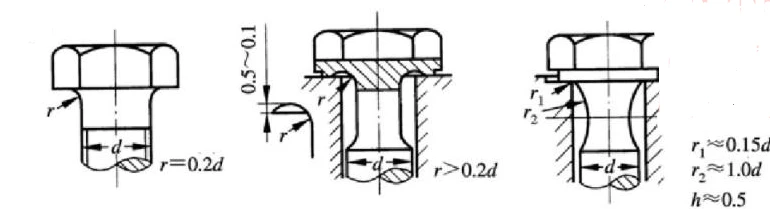
Following the same principle as the R angle for threads, we can also machine an R angle within the allowable range at the junction of the bolt head and the thread.