


Previously, we discussed why hexagon nuts are widely used in daily life and various industries. The convenience brought by the hexagonal design also supports the extensive application of hexagon bolts and screws. When it comes to hexagon socket head bolts and hexagon head bolts, what are their similarities and differences? This article provides a detailed analysis of their characteristics from the perspectives of appearance, fastening tools, cost efficiency, advantages and disadvantages, and suitable application scenarios.
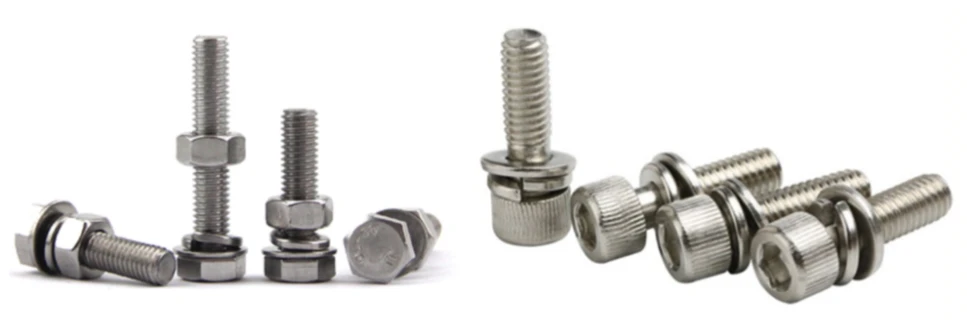
Differences in Appearance
As the name suggests, a hexagon head bolt/screw has an exposed hexagonal flat head with a simple and common shape. In contrast, hexagon socket head bolts feature a distinctive design: the outer circle of the head is round, with a hexagonal recess machined in the center. Typical types include hexagon socket cap head bolts, as well as pan head, countersunk head, flat head variants and special set screws. This diversified design expands the scope of application scenarios.
Selection of Fastening Tools
For hexagon head bolts, common fastening tools include adjustable wrenches and box wrenches. These tools match the bolt heads and allow easy operation. By comparison, hexagon socket head bolts require dedicated L-shaped hex keys. The long arm of the hex key provides leverage for labor-saving and efficient tightening.
Cost and Economic Benefits
In terms of cost, hexagon head bolts have a simple structure and relatively low production cost, roughly half that of hexagon socket head bolts.
Advantages and Disadvantages
Hexagon Head Bolts Advantages: Good self-locking performance, wide pre-tightening contact surface, broad available range of fully threaded length for load bearing. They can be positioned via reamed holes to withstand transverse shear force.
Disadvantages: The head occupies large space, making them unsuitable for compact installation environments.
Hexagon Socket Head Bolts Advantages: Easy to tighten, space-saving, aesthetically pleasing and capable of high load bearing. They are particularly suitable for applications requiring countersunk installation.
Disadvantages: The small contact area limits the maximum preload. The requirement for dedicated hex keys increases the difficulty of maintenance.
Application Scenario Analysis
Hexagon head bolts are preferred for mass equipment assembly and applications with heavy loads or low precision requirements. On the contrary, hexagon socket head bolts are irreplaceable for precision machinery, layouts with limited space, and assemblies with strict aesthetic requirements.
Conclusion
Hexagon socket head bolts and hexagon head bolts each have their own merits. In practical engineering, selection is not limited to a single type. Fasteners should be flexibly matched according to specific requirements to achieve optimal fastening performance and economic benefits. In the field of fasteners, diversified options deliver wider adaptability and higher efficiency.


