


Black oxide finishing (also known as bluing) is a common chemical surface anti-corrosion process for steel materials. It is not a heat treatment process and is fundamentally different from quenching and tempering, which alter the internal metallographic structure of metals. Its working principle is to form a dense and stable oxide film on the steel surface through chemical reactions to isolate air and moisture and achieve rust and corrosion resistance. This process only acts on the workpiece surface without changing the internal structure or mechanical properties of steel. It is suitable for bolt workpieces with low appearance requirements and ordinary anti-corrosion grades.
Core Functions of Bolt Surface Galvanizing
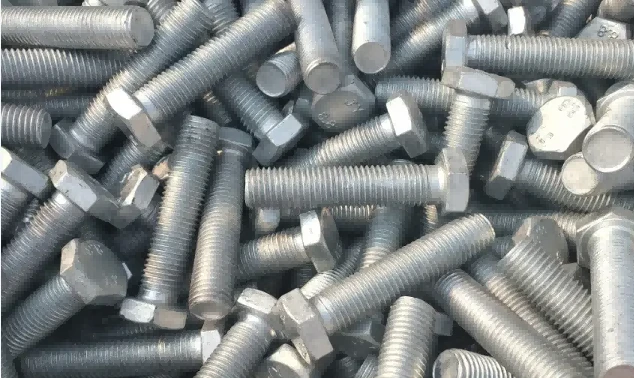
Galvanizing is a surface protection technology that coats a zinc layer on the surface of steel, alloy and other materials. It mainly provides rust prevention, corrosion resistance, improved appearance and extended service life. As one of the most mainstream surface treatment methods for bolts, industrial galvanizing processes are dominated by hot-dip galvanizing and electro-galvanizing. Compared with black oxide finishing, galvanizing delivers stronger anti-corrosion performance and wider adaptability, meeting the service requirements of outdoor, humid, salt spray and other harsh working conditions.
Anti-Corrosion Performance Comparison Between Electro-Galvanizing and Dacromet Coating
The conventional thickness of Dacromet coating ranges from 6 to 8 μm, providing stable protection against red rust for 480 hours in a neutral salt spray test. When the coating thickness reaches 10 μm, the salt spray resistance time can exceed 800 hours. In contrast, ordinary electro-galvanizing only achieves a salt spray resistance of approximately 96 hours, showing a significant gap in anti-corrosion capability.
According to the electrochemical anti-corrosion principle, zinc and aluminum serve as anodic metals while steel acts as the cathode. Electro-galvanizing forms a pure zinc coating directly on the steel surface, allowing corrosive media and current to flow easily across the zinc layer. In salt spray environments, the highly active zinc layer undergoes preferential electrochemical corrosion, forming white rust in a short period. Once the zinc layer is completely consumed, red rust appears on the steel substrate, resulting in a short overall anti-corrosion service life.
Dacromet is a highly dispersed water-based composite coating composed of ultra-fine zinc flakes, aluminum flakes, chromium oxide and special organic additives. After coating, the workpiece is cured at a high temperature of 300℃. During the curing process, hexavalent chromium in the coating is reduced to chromium sesquioxide, forming stable amorphous composite chromate compounds. These compounds passivate the 0.2 μm thin zinc and aluminum flakes, granting them moderate conductivity and stable sacrificial anode protection performance.
The passivated zinc and aluminum flakes inside the Dacromet coating overlap layer by layer to form a dense multi-layer physical barrier structure. This greatly extends the conduction path of corrosive current, slows down the corrosion consumption of zinc and aluminum layers, and realizes long-term anti-corrosion effects. In addition, the dry Dacromet film contains no crystal water, exhibiting excellent high-temperature resistance and thermal corrosion stability. It also features outstanding recoating performance and can form firm adhesion with most conventional coatings (except acidic paints), making it suitable for secondary composite coating protection processes.


