


During the welding of steel structure bolts, uneven heating and cooling, together with internal structural constraints and external assembly restrictions, will result in residual welding stress inside the components after welding. Residual welding stress reduces the actual bearing capacity of welded joints and causes plastic deformation. Excessive residual stress may further lead to component deformation, cracking and even structural damage, seriously affecting the safety and stability of steel structures.
1. Functions of Post-Weld Hydrogen Removal Heat Treatment
Post-weld hydrogen removal is a low-temperature heat treatment process, which must be carried out before the weld temperature cools down below 100℃. The standard process parameters are a heating temperature of 200℃ to 350℃ and a holding time of 2 to 6 hours. This process accelerates the escape of free hydrogen from the weld and heat-affected zones, effectively preventing cold cracks and delayed cracks in low-alloy steel welds and greatly improving the stability of welded joints.
2. Functions of Post-Weld Stress Relief Heat Treatment
Stress relief heat treatment reduces the yield strength of steel at high temperature so as to release and homogenize residual welding stress, serving as an essential post-weld process for steel structure fabrication. It mainly includes two methods: overall high-temperature tempering and local high-temperature tempering.
Overall high-temperature tempering: The entire welded component is placed in a heating furnace, heated gradually to the specified temperature, held at a constant temperature, and then cooled in the furnace or in ambient air. This method can eliminate 80% to 90% of residual welding stress, achieving an excellent stress relief effect.
Local high-temperature tempering: Only the weld seam and adjacent heat-affected areas are locally heated and then cooled slowly. It reduces local stress peaks and balances stress distribution, achieving partial stress relief. This method is suitable for large-scale steel structural components that cannot be integrally placed in heating furnaces.
3. Improvement of Welded Joint Performance by Heat Treatment
After the welding of certain alloy steels, hardened microstructures are easily formed in welds and heat-affected zones, resulting in reduced plasticity, toughness and degraded mechanical properties of the joints. In addition, the combined effect of residual stress and hydrogen embrittlement may cause severe damage to hardened welded joints. Standardized post-weld heat treatment optimizes the metallographic structure and refines the grain of welds, significantly improving the plasticity, toughness and comprehensive mechanical properties of welded joints, and ensuring the connection strength and long-term service stability of steel structures.
4. Classification of High-Strength Steel Structure Bolts
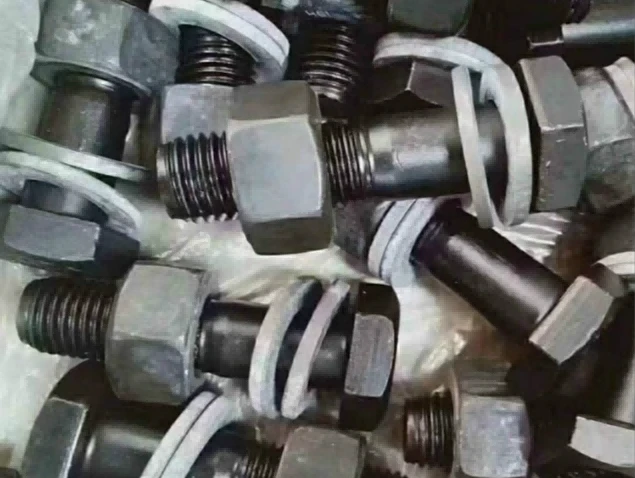
High-strength steel structure bolts are mainly divided into two categories: large hexagon high-strength bolts and shear-twist high-strength bolts. Large hexagon high-strength bolts are conventional high-strength threaded fasteners. Shear-twist high-strength bolts are optimized and improved based on large hexagon bolts, featuring better construction adaptability, accurate preload control and minimized manual construction errors.
5. Construction Specifications and Precautions for Steel Structure Bolts
The tightening of high-strength steel structure bolts must follow the standard two-step procedure of preliminary tightening and final tightening. One-step full tightening is strictly prohibited. Preliminary tightening can be completed with impact electric wrenches or adjustable torque electric wrenches to eliminate gaps between connecting plates and uniformly distribute preload.
Specialized tools shall be adopted for final tightening according to bolt types: shear-twist high-strength bolts must be tightened with dedicated shear-twist electric wrenches, with tail breaking as the standard of qualified tightening; large hexagon high-strength bolts must be finalized with torque electric wrenches in strict accordance with the design torque value.
In terms of structural composition: a complete set of large hexagon high-strength bolt assembly consists of one bolt, one nut and two washers; a shear-twist high-strength bolt assembly consists of one bolt, one nut and one washer. Original matching accessories must be used during installation, and mixed assembly of different accessories is forbidden.


