


In order to meet the large-scale and assembly line production mode in the automobile industry or construction machinery industry, the sub parts are usually produced by each sub supplier, and then the sub parts are assembled by welding, riveting, bonding and bolt connection. The bolt connection design is simple, the parts are standardized and the assembly is simple It is widely used because of its high efficiency and disassembly. Bolt connection is generally controlled by pre-set torque. Due to the friction between flange and thread pair, about 90% of the torque is used to overcome the friction. The bolt can produce good tension to clamp the workpiece before the yield point of the bolt. However, the greater the force is not set, the better. If the yield point of the bolt is exceeded, the greater the force is, the better, Plastic deformation and even fracture may occur. Therefore, in the assembly and tightening of key parts, the reliable tightening process can be established by analyzing the clamping force to ensure the reliability of the connection.
1、 Principle of bolt connection and fastening
Drill holes at the joint of the two components and connect them by bolts. In the process of tightening, the bolts are stretched axially by the tightening force. After reaching the torque point, the two components are tightened by the tension of the bolts (see Figure 1). Under the same conditions, increasing the length of the screw can make the bolt extend better and obtain greater clamping force.

It should be noted that there is a linear relationship between torque and clamping force in the range of bolt elastic deformation. The tightening of the bolt should not exceed the limit of use. If it reaches the yield point, it will lose the ability of springback and produce plastic deformation or even fracture. With the increase of bolt grade, its tensile strength will also increase. Therefore, the bolt grade and the torque required for tightening should be determined according to the actual situation of yield. For the key bolts in the engine, grade 12.9 bolts are generally selected to obtain higher tensile strength.
The torque can be directly measured by manual torque wrench and electric tightening gun, but the clamping force is more concerned. The clamping force is not as simple as the applied torque. In the same bolt tightening process, before plastic deformation occurs, the more the bolt is rotated, the greater the torque is. However, with the increase of torque, the clamping force does not necessarily increase linearly, because 90% of the torque is consumed by the friction between the bolt and flange and the friction in the thread pair, and the friction factor has a large dispersion. Take two examples, for example, if there is welding slag or thread damage on the screw of a bolt, the bolt may not be in place when it is tightened to the target torque; if the thread is oiled before tightening the bolt, higher clamping force can be obtained by reducing friction under the same torque. Therefore, higher clamping force requirements, in addition to the torque method, can use torque control and angle monitoring, or angle method tightening and other advanced tightening process.
2、 Ultrasonic clamping force measurement method
In order to better control the tightening effect, in the engine factory, it is generally necessary to analyze the clamping force for important bolt connections such as cylinder head bolt, connecting rod bolt and main bearing cap bolt to obtain better process control

The process of clamping force measurement and analysis can be greatly reduced by ultrasonic measurement analyzer. The measuring equipment is composed of pulse generator, temperature sensor, measurement and analysis software, ultrasonic pick-up sensor and cable. The axial load is proportional to the elongation when the bolt is tightened, which is conducive to the propagation time difference of ultrasonic wave along the axial force direction in the bolt medium, and can be changed according to the axial load The main steps are as follows: 1
① Determine the relationship between bolt pre tightening force and elongation: in order to reduce variation, the tested bolts should come from the same batch as the bolts when measuring clamping force. The bolt is assembled on the calibration tooling. After setting the bolt grade, bolt specification, total length, clamping length and other information, the relationship between preload and elongation is obtained by measuring instrument during torque application, and the calibration file is generated.

② Calibration of the initial length of the bolt: before measuring the clamping force, calibrate the initial length of the bolt to be analyzed, stick the acoustic pickup sensor on the top of the bolt, and use the measuring instrument to pick up the initial length ripple.
③ Measurement and analysis of clamping force: after assembling the parts according to the set process, tighten the bolts, clean the sample surface, connect the acoustic pick-up sensor to the bolt patch, and the measuring instrument emits the ultrasonic signal. According to the reflected ripple and time, combined with the initial length of the bolt, the elongation of the bolt after tightening is calculated, and the clamping force is finally determined according to the relationship between the calibration documents .
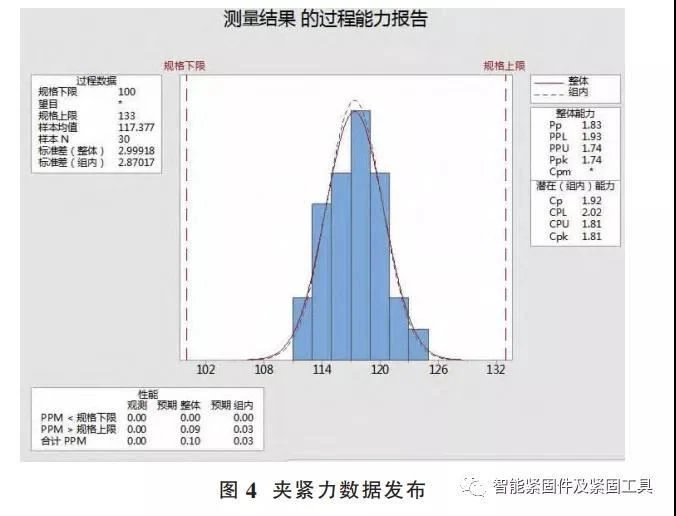
④ Quality control of clamping force analysis: when using ultrasonic analysis, because the ambient temperature is kept constant, the top and bottom of the bolt must be grinded to obtain enough parallel smooth plane, so as to facilitate ultrasonic reflection and obtain more accurate results. In the research, more samples should be used for measurement, and the measurement results should be analyzed in real time. When there are abnormal values, multiple verification should be adopted to eliminate the measurement error. According to the principle of statistics, the sample size should be at least more than 30, and the data will obey or approximately obey the normal distribution.

3 Summary
Using ultrasonic measurement and analysis technology can achieve non-destructive, rapid detection, detection results can be found, greatly improving the efficiency and accuracy of measurement. Through the analysis of clamping force, it can provide guidance and correction for tightening process, which can better control tightening process and improve quality than using torque wrench to detect static torque.


