


Lock nuts are commonly used connectors in the mechanical field, and their national standards and specification sizes are clearly stipulated in detail. The main factors affecting the performance of lock nuts include material strain hardening, low-cycle fatigue, friction coefficient, manufacturing and assembly accuracy, and necking value.
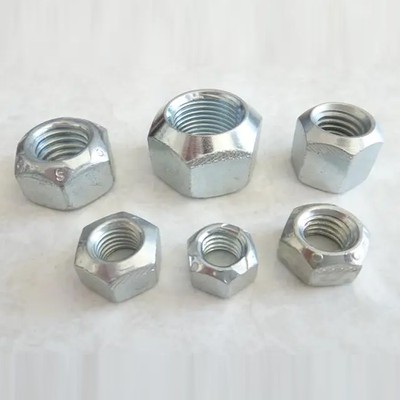
Lock nuts are generally made of alloy steel, which is a cyclic strain hardening material. During the cyclic loading process, the strain hardening of the thread tabs will lead to an increase in their elastic recovery force, thereby increasing the unscrewing torque.
During the use of lock nuts, they need to bear continuous reciprocating cyclic loads. Such cyclic loads are likely to cause low-cycle fatigue of the thread tabs, resulting in a decrease in the pressing force of the thread tabs and a subsequent reduction in the unscrewing torque.
The friction coefficient is one of the important factors affecting the maximum unscrewing torque of lock nuts. Under the action of cyclic reciprocating friction, the rough parts and edges of the thread tabs will be smoothed, resulting in a decrease in the friction coefficient, which in turn reduces the maximum unscrewing torque of the nut.
Manufacturing technology and assembly accuracy also have an impact on the key performance of lock nuts. If there are sharp corners on the thread edges or inconsistent dimensional fit between parts, the screwing-in and unscrewing torques may fluctuate. It is necessary to go through a certain number of running-in times to obtain more stable and accurate reusability characteristics of lock nuts.
The necking value refers to the degree of opening of the thread tabs in the lock nut, and its change will have a significant impact on the reusability characteristics of the lock nut. An increase in the necking value will increase the deformation of the thread tabs when they are opened, intensify the cyclic strain hardening phenomenon, and at the same time increase the pressing force of the thread tabs, which has a tendency to increase the unscrewing torque; however, on the other hand, an increase in the necking value will lead to a decrease in the total contact area between the thread tabs and the bolt, a reduction in the friction force between them, an increase in the strain of the thread tabs, and a decrease in low-cycle fatigue performance, which has a tendency to reduce the maximum unscrewing torque.
In general, under the combined action of various factors, the change rule of the maximum unscrewing torque of the lock nut with the number of reuses is difficult to predict, and it can only be observed and verified through experiments. In practical applications, it is necessary to select a suitable lock nut according to the specific working conditions, and regularly inspect and replace it to ensure its normal performance and achieve the expected locking effect.


