


Convex welding is an efficient welding method that can perform multi-point welding simultaneously, and can be used to replace arc welding, brazing, and biting. This method has a fast processing speed and no other consumption except for electricity, which is a major feature. Today, the editor will share with you the advantages of convex welded nuts compared to welded nuts?

What is a convex welding nut?
The so-called convex welding nut is mainly used for welding stamping parts of low carbon steel and low alloy steel. There are many types of convex welding, including convex welding of bolts and screws, cross convex welding of wires, convex welding of pipes, and T-shaped convex welding of plates, in addition to plate convex welding.
Advantages of convex welding nuts:
1. In one welding cycle of the welding machine, multiple welding points can be welded simultaneously on the inner shell. The number of welding points that can be welded at a time depends on the uniform electric force and welding current that the welding machine can apply to each bump.
2. Due to the concentration of welding current on the convex points and the absence of shunt problems through adjacent welding points, a smaller overlap amount and smaller point spacing can be used.
3. The position of convex solder joints is more precise than that of spot solder joints, and due to the uniform size of convex solder joints, the quality of convex solder joints is more stable. Therefore, the size of convex solder joints can be smaller than that of welded solder joints.
4. Due to the ability to place convex points on one component, it can minimize the traces on the exposed surface of another component to the greatest extent possible.
5. The flat large electrode used in projection welding has much less heat and wear compared to spot welding electrodes, extending its service life and saving time for repairing and replacing electrodes, as well as reducing electrode maintenance costs.
6. Due to the ability to weld multiple points simultaneously with smaller protrusions, welded components with minimal deformation can be obtained.
7. Convex welding can effectively overcome the offset of fusion nuclei, thus allowing for the welding of parts with a thickness ratio of up to 6:1.
Disadvantages of convex welding nuts:
1. Sometimes additional processes are required to prefabricate one or more protrusions.
2. When welding multiple welding points with the same electrode at the same time, the alignment of the workpiece and the size (especially height) of the protrusions must maintain high-precision tolerances to ensure uniform electrode force and welding current, in order to make the quality of each welding point uniform and consistent.
3. Simultaneously welding multiple welding points requires the use of high-power welding machines with high electrode pressure and mechanical precision, and their pressure mechanism has high flexibility in application.
Next, let's review the characteristics of welded nuts:
Welded nut is a type of nut that is suitable for welding on the outside of the nut. It is usually made of weldable materials and is relatively thick, suitable for welding. Welding is equivalent to turning two separate parts into a whole, melting the metal at high temperature, mixing it together, and then cooling it. Alloy is added in the middle, and the internal strength is generally greater than that of the parent material due to the action of molecular force. The experiment of welding parameters should be based on the fusion size of the weld seam, and the welding parameters should be adjusted according to the fusion size until the defect is eliminated. Of course, the quality of welding is related to the pre-treatment before welding, such as cleaning dust and oil stains.
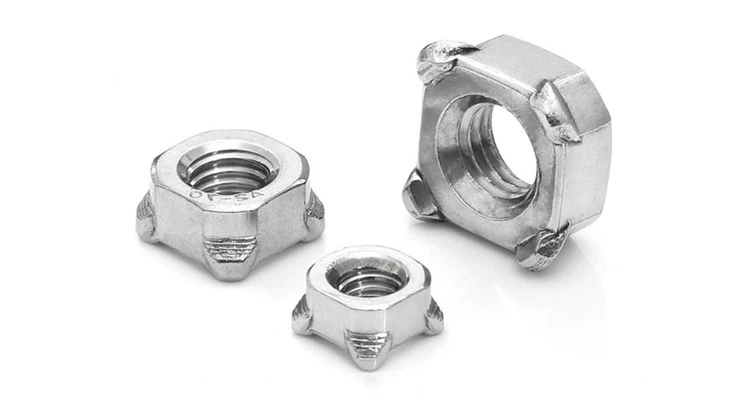
Advantages and disadvantages: Welding has a relatively high strength and a wide range of applications. Both thickness and thickness are acceptable, but high temperatures can cause deformation of the connected parts and cannot be disassembled. Additionally, some reactive metals such as aluminum and magnesium cannot be welded using conventional methods and require protectors or argon arc welding, requiring processing technology and precision.
What are the advantages of convex welded nuts compared to welded nuts? There are mainly the following points:
1. Multiple welding points can be welded simultaneously within one welding cycle. Not only does it have high productivity, but it also has no diversion effect. Therefore, solder joints can be arranged on narrow areas without being limited by the distance between points.
2. Due to the concentration of current density on the convex points, a lower current can be used for welding, and smaller fusion nuclei can be reliably formed. It is difficult to form a weld nugget smaller than a certain size corresponding to a certain plate thickness during spot welding.
3. The position of the convex points is accurate, the size is consistent, and the strength of each point is relatively uniform. Therefore, for a given strength, the size of the convex welding point can be smaller than that of spot welding.
4. Due to the use of large planar electrodes and the placement of protrusions on one workpiece, the indentation on the exposed surface of another workpiece can be minimized to the greatest extent possible. At the same time, the current density of the large planar electrode is low, the heat dissipation is good, and the wear of the electrode is much smaller than that of spot welding, thus greatly reducing the maintenance and repair costs of the electrode.
5. Compared with spot welding, the influence of oil, rust, oxide scale, coating, and other coatings on the surface of the workpiece on projection welding is relatively small, but a clean surface can still achieve relatively stable quality.
Due to the various advantages mentioned above, convex welding has been widely used. The drawback of convex welding is that it requires an additional process of punching convex welding; The electrodes are relatively complex; Due to the need to weld multiple solder joints at once, high-power welding machines with high electrode pressure and high mechanical precision are required.


