


The core of all fasteners (excluding pins and retaining rings) lies in their threads. Without threads, fastening engagement cannot be achieved (except for special fasteners such as rivets). Threads are regular helical ridges and grooves machined on the metal surface; the mutual rotation and engagement of two matching threads form a complete locking function. Commonly used threads in China include British standard threads and metric threads, which have certain differences. The accuracy grades of British standard external threads are designated as 1A, 2A, 3A, while those of British standard internal threads are marked as 1B, 2B, 3B. Metric thread specifications are denoted by M followed by the nominal diameter in millimeters, such as M12, and their fit accuracy grades are usually labeled with symbols like 6g, 5g for external threads and 6H, 5H for internal threads. Whether it is metric thread or British standard thread, the higher the thread grade, the better the fit accuracy.
Screws are prone to corrosion during packaging, storage or transportation. The screws themselves are fully compliant with standards, but after long-distance transportation to customers, rust spots may appear on the surface due to various reasons, leading to product returns and other unnecessary losses. The main cause of screw rusting is that components such as moisture and carbon dioxide in the atmosphere corrode the material surface when the screws come into contact with the air, resulting in the formation of rust spots. Therefore, we need to take effective protective measures during these processes.
Thus, electroplating technology has been developed and applied. Electroplating is not only for enhancing the aesthetic appearance of screws, but more importantly, for rust prevention. Current electroplating technology is quite mature, including processes such as electrogalvanizing, hot-dip galvanizing, and nickel plating. The corresponding electroplating method can be selected according to actual needs.
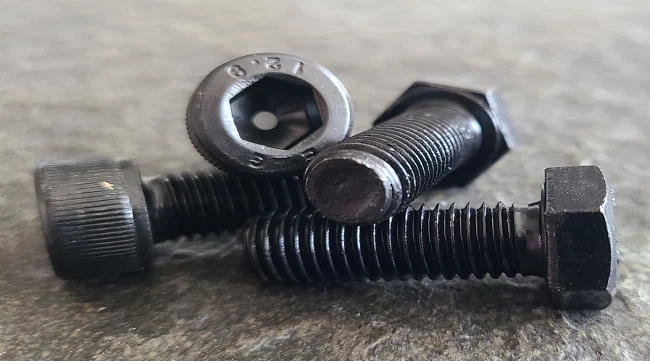
For commonly used Grade 12.9 high-strength screws, their surfaces are generally not subjected to electroplating treatment during daily use and storage. This is because electroplating Grade 12.9 high-strength screws is likely to cause hydrogen embrittlement, a problem that is mostly uncontrollable and sudden. In other words, it is impossible to predict when the screw may break off due to this issue. Therefore, after the production of Grade 12.9 high-strength screws, their surfaces will undergo an oxidation blackening process. This oxidation blackening treatment is not the ordinary black oxide boiling we commonly see; instead, it is a specialized process completed through high-temperature treatment and strict production procedures. The treated screws have a shiny black surface with a slight oily film, which does not affect their normal use at all. They can be stored in a daily environment for many years without rusting. Some specifications of Grade 12.9 screws stored in the warehouse of Wuxi Fan'ao Fastener Co., Ltd. have been kept for more than ten years and still show no signs of corrosion to this day.


